Documentation
SimScale allows its users to model advanced flow characteristics, like momentum sources or porous media, which would otherwise require sophisticated geometries or large meshes leading to expensive simulations. This modeling can be done using the Advanced concepts feature in the simulation tree:
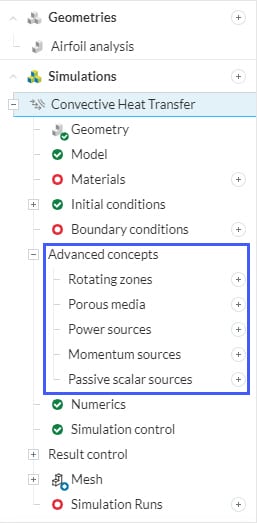
The options available for modeling depend on the chosen analysis type —a general description of all advanced concepts can be found below. For a list of advanced concepts available for each analysis type, please check Table 1 of this documentation page.
Rotating zones can be used to model rotating systems such as turbines, fans, ventilators, and similar systems. Two types are available: MRF (Multiple Reference Frame) and AMI (Arbitrary Mesh Interface).
Solid body motions can model the effect of the movement of the solid body sitting inside the fluid domain. This includes linear, rotating, and oscillating motions. Another option available within this result control is Ship design analysis.
With this option, a volume within the simulation domain can be modeled as a porous medium avoiding the need for a porous geometry and subsequently a fine mesh.
To model the heat generation from a volume it can be defined as a power source. Power sources can be assigned as either an absolute or a specific value.
Momentum sources can be used to simulate fans, ventilators, and other similar devices without having to model the exact geometry and motion of the device. Two options are available within momentum sources: Average velocity and Fan model.
Passive scalar sources can be used to simulate the propagation of species like smoke from a burning car in a garage or the diffusion of dust or pollutants in a tunnel. This is only valid if these species get transported with the fluid without having any effect on the flow physics.
It can be used to approximate the effect of heat sources and heat transfer from that source to the surrounding domain without explicitly having to resolve the source geometry itself.
The contact resistance advanced concept is exclusive to the conjugate heat transfer (IBM) analysis type, allowing users to define additional thermal resistance to contact of interest.
The table below contains an overview of which advanced concepts are available for each CFD analysis type:
| Analysis Type | Available Advanced Concepts |
| Incompressible | Momentum source, passive scalar source, porous media, rotating zone, and solid body motion (only if transient) |
| Multi-purpose | Porous media, rotating zone |
| Compressible | Porous media, rotating zone |
| Convective heat transfer | Momentum source, passive scalar source, porous media, power source, and rotating zone |
| Conjugate heat transfer | Momentum source, passive scalar source, porous media, power source, thermal resistance network, and rotating zone |
| Conjugate heat transfer (IBM) | Momentum source, porous media, power source, contact resistance, rotating zone, thermal resistance network, and passive scalar source |
| Multiphase | Rotating zone, solid body motion |
For Pedestrian Wind Comfort and Incompressible (LBM) analysis types, this feature is addressed as Advanced modelling.
Last updated: May 21st, 2025
We appreciate and value your feedback.
What's Next
Rotating Zonespart of: Advanced Concepts
Sign up for SimScale
and start simulating now
