Documentation
With our lattice Boltzmann method (LBM), it is possible to input additional modeling of geometry in the form of surface roughness and porous media to better capture its effects on the wind comfort simulation for an accurate analysis. Additionally, it is possible to include a rotating wall as an advanced concept.
Surface roughness has an influence on friction resistance. While the effect of roughness for laminar flows is negligible, turbulent flows are highly dependent on wall roughness. Because roughness changes the thickness of the viscous sublayer and modifies the law-of-wall for mean velocity. As a result, the turbulent friction factor increases with the roughness ratio.
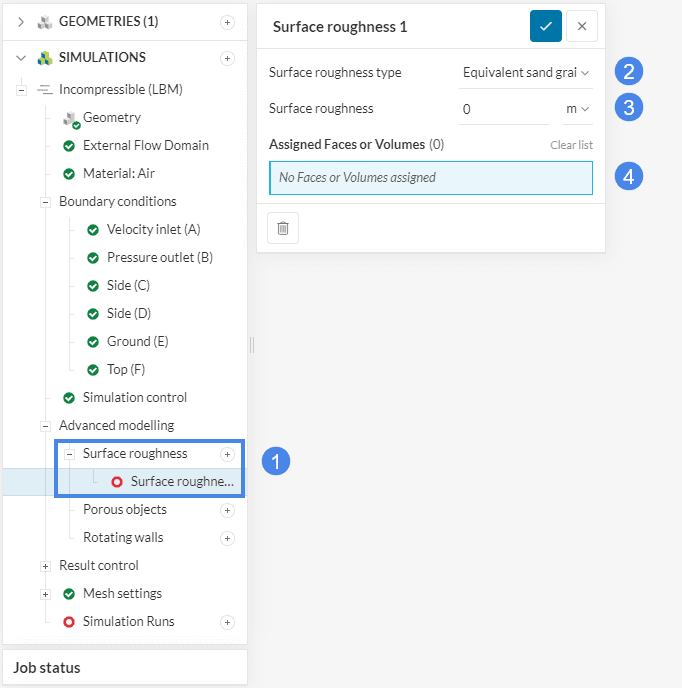
In LBM simulations, wind flow is affected by frictious surfaces as well as obstacles, such as terrain, buildings, trees, etc. Roughness effects on any surface in LBM analysis can be applied under Advanced modeling. SimScale allows for two definitions of surface roughness type, Equivalent Sand Grain and Aerodynamic.
To learn more about how surface roughness affects the simulation (both LBM and PWC), please have a look at this article:
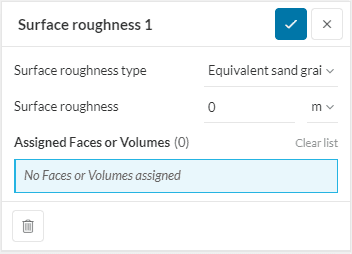
When the roughness of the specific surface is known the Equivalent sand grain method allows the direct assignment of a surface roughness value. Typical values reach from 0.05 \(mm\) for steel to 3 \(mm\) for concrete.
In the following table, the equivalent sand-grain roughness of some materials and terrain types can be seen:
| Material | \(k_{s}\), Equivalent sand-grain roughness \([m]\) |
|---|---|
| Concrete, smooth wall | 0.0045 |
| Concrete, rough wall | 0.013 |
| Concrete, floor | 0.04 |
| Rubble | 0.0175 |
| Farmland | 0.135 |
| Farmland with crops | 0.525 |
| Grass with shrubs | 0.265 |
| Shrubbery | 0.5 |
| Grass and stone grid | 0.0225 |
| Gravel | 0.075 |
| Case iron | 0.000254 |
| Commercial or welded steel | 0.00004572 |
| PVC | 0.000001524 |
| Glass | 0.000001524 |
| Wood | 0.0005 |
| Cast iron | 0.00026 |
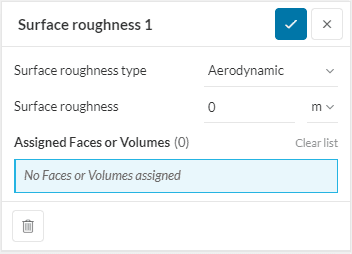
The Aerodynamic surface roughness type is used to model the large-scale effects of non-modeled obstacles on the atmospheric boundary layer flow, such as vegetation, or benches. Typical values range from 0.0002 \(m\) for open sea to 1 \(m\) for dense urban areas. A few example values can be found in Table 2. Where \(x \over\ H\) is the ratio of length to the height of the obstacle.
| Terrain description | \(z_0\) \([m]\) |
| Open sea, fetch at least 5 \(km\) | 0.0002 |
| Mudflats, snow: no vegetation, no obstacles | 0.005 |
| Open flat terrain: grass, few isolated obstacles | 0.03 |
| Low crops: occasional large obstacles, \(x \over\ H\) > 20 | 0.10 |
| High crops: scattered obstacles, 15 < \(x \over\ H\) < 20 | 0.25 |
| Parkland, bushes: numerous obstacles, \(x \over\ H\) ≈ 10 | 0.5 |
| Regular large obstacle coverage (suburb, forest) | 1.0 |
Porous media is a medium filled with solid particles, which lets fluid pass through. The arrangement of the flow path inside the porous medium can be regular or irregular.
A porous medium can be classified as follows:
Porous media is used to model permeable obstructions such as trees, hedges, windscreens, and other wind mitigation measures. When air flows through a porous body, a pressure gradient along the direction of the flow is generated. Using porous media simplification reduces CAD and mesh complexity, and saves computational time and expenses.
Within the LBM analysis type, SimScale allows users to model porous objects using the following two models:
The pressure loss due to porosity is modeled by the empirical Darcy-Forchheimer equation where, \(\Delta p/\Delta x\) is pressure gradient, \(\mu\) is dynamic viscosity, \(\rho\) is density, \(u\) is velocity vector, \(F_\varepsilon\) is friction form coefficient and \(K\) is permeability.
$$\overline{\frac{\Delta {p}}{\Delta x}}=- \frac{\mu}{K}.\overline{u}-\rho.\frac{F_\varepsilon}{\sqrt{K}}.|\overline{u}|.\overline{u}\tag{6}$$
The first and the second term on the right-hand side of the equation are the Darcy and Forchheimer terms respectively. The Darcy term accounts for the friction drag which has a linear relation to the local velocity vector. The Forchheimer term accounts for the inertial drag or the form drag which has a quadratic relation to the local velocity vector.
To be able to define a porous media in SimScale, one should define \(K\) and \(F_\varepsilon\). Users can extract these coefficients. Just use a minimum of 3 data points and predict the \(K\) and \(F_\varepsilon\) to fit the line. An example is shown below:
| u \([m/s]\) | dP/dx \([Pa/m]\) |
|---|---|
| 1 | 9.88 |
| 4 | 123.33 |
| 16 | 1852.84 |
Curve equation:
$$ \frac{\mathrm dP}{\mathrm d x} = \frac{0.0000181}{K}.u+1.\frac{F_\varepsilon}{K^{0.5}}.u^2 \tag{7} $$
Using the curve-fitting method, missing coefficients were calculated as follows:
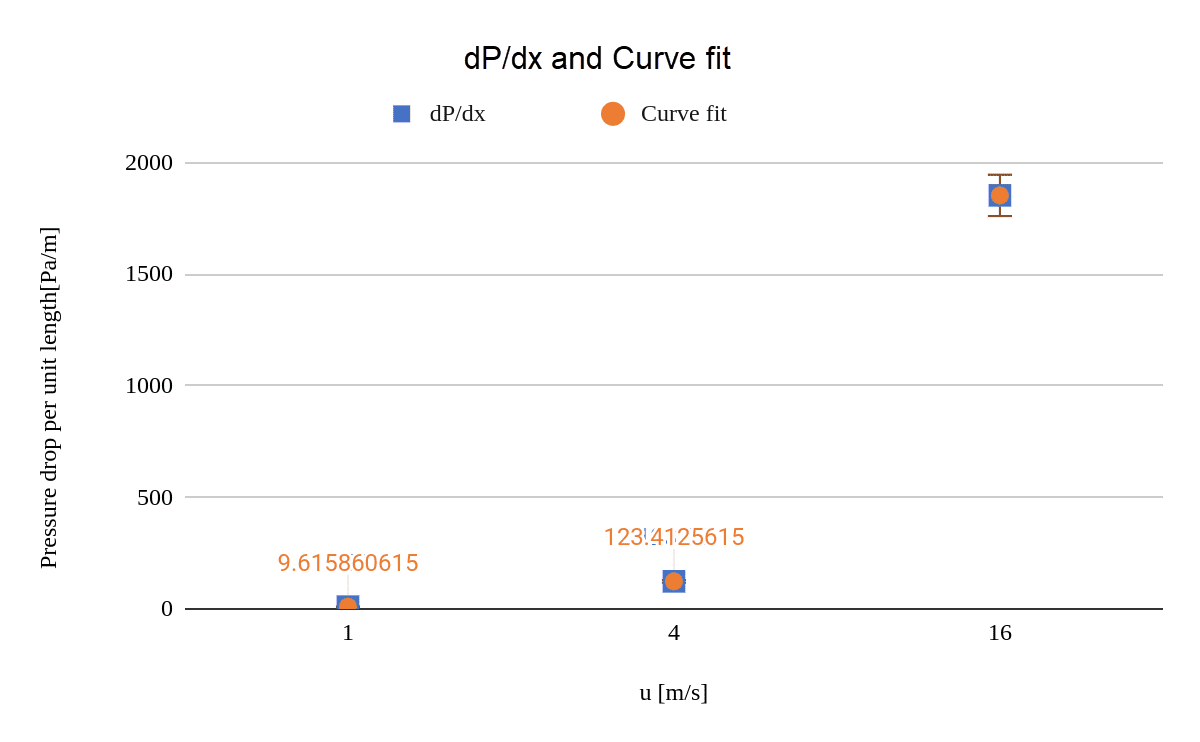
Once the relevant coefficients are found, assign them in Darcy-Forchheimer porous object definition and select the porous media geometry. This selection can be in the form of faces, volumes or geometry primitives.
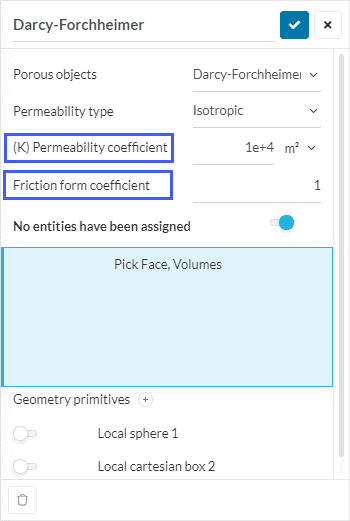
While the isotropic type adds specific resistance in every direction, directional adds the specific resistance only on specified direction/s and assigns the remaining direction/s an infinite resistance (such as a wall).
Tree models are used to model the vegetation (single trees, bushes, hedges, forest canopies, etc.) as porous mediums. The user can either define the porosity as a custom tree model or choose one of the 5 most common trees in EU cities:
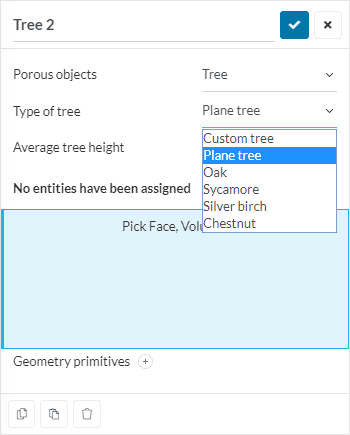
Custom tree model is also possible, and requires user input for assigning:
Leaf area index (LAI) is a dimensionless number, which is used to compare plant canopies. It can be simply defined as the total leaf area per unit ground area.
Default tree models require only the assignment of tree height since the solver applies related LAI and drag coefficient automatically. The following table displays the default trees, and their respective LAI along with the drag coefficient:
| Tree Type | Drag Coefficient | Leaf Area Index (LAI) |
|---|---|---|
| Plane tree | 0.2 | 5.28 |
| Oak tree | 0.2 | 5.1657 |
| Sycamore | 0.2 | 2.9675 |
| Silver birch | 0.2 | 3.2379 |
| Chestnut | 0.2 | 5.1972 |
The above information obtained\(^2\) is a compiled data ranging over 70 years from 500 different locations.
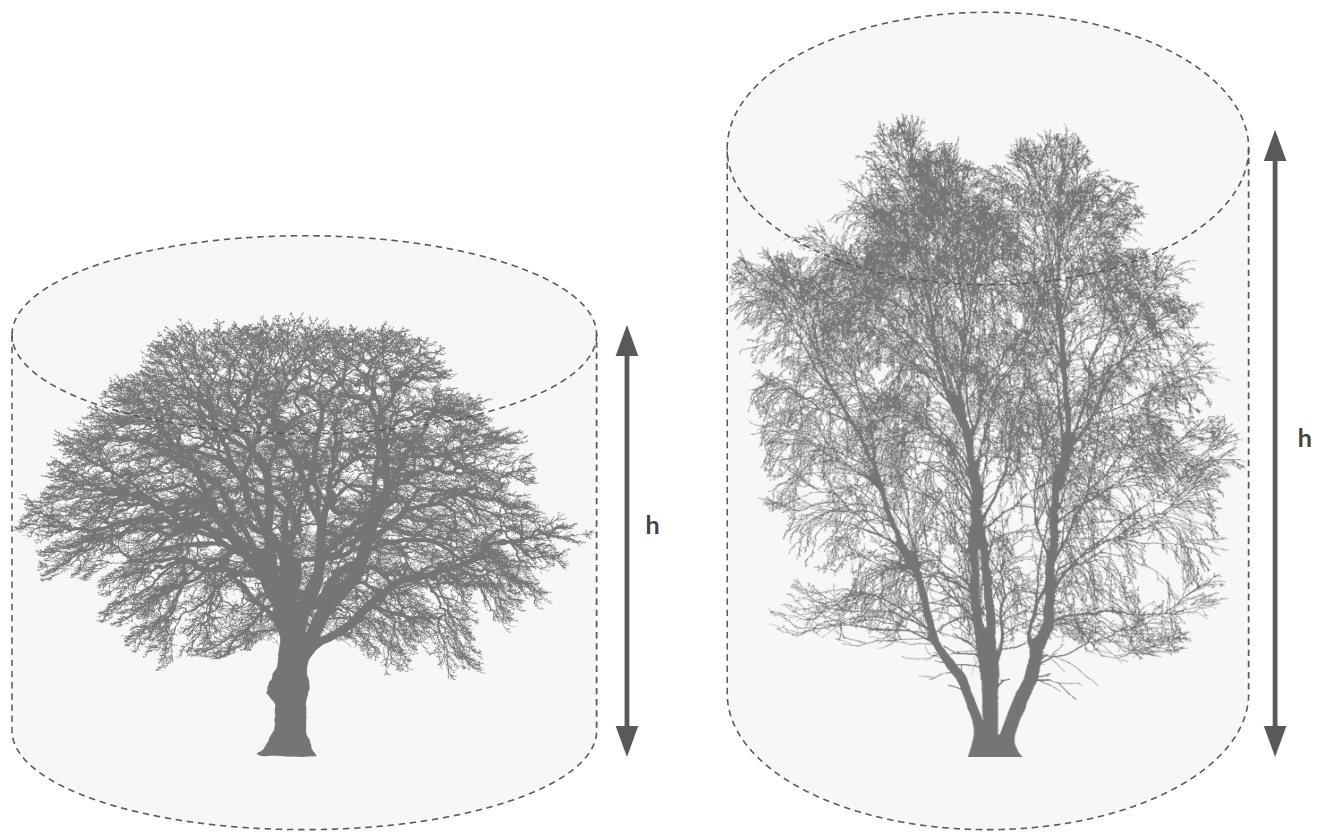
In the tree model, we used the modified Darcy-Forchheimer equation. By assigning a high permeability value, we neglected the Darcy portion and simplified the equation as follows:
$$\frac{\Delta \overline{p}}{\Delta x}=-\rho.\frac{F_\varepsilon}{\sqrt{K}}.|\overline{u}|.\overline{u}\tag{8}$$
Next, modified the equation to define it with respect to Drag Coefficient \(C_d\) and Leaf Area Density \(LAD\):
$$\frac{\Delta \overline{p}}{\Delta x}=-\rho.LAD.C_d.|\overline{u}|.\overline{u}\tag{9}$$
Leaf area density is calculated with respect to leaf area index \(LAI\) and height of the vegetation \(h\):
$$LAD=\frac{LAI}{h}\tag{10}$$
Read more about modeling trees in SimScale in our blog:
Rotating walls can be found under Advanced concepts in LBM simulation:
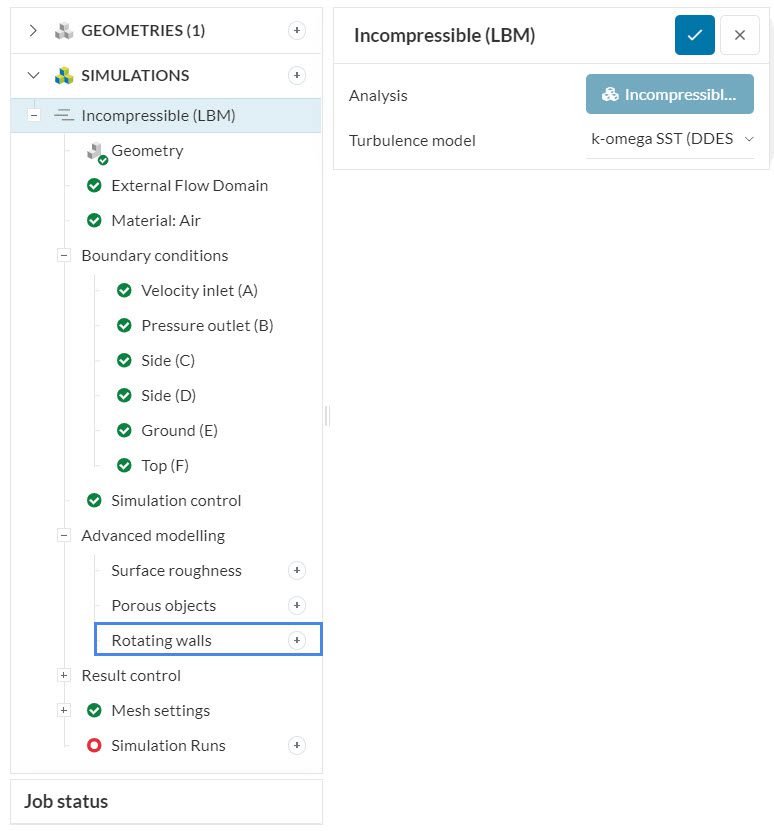
Here, the origin, axis of rotation, and the rotational velocity of the body must be defined accordingly:
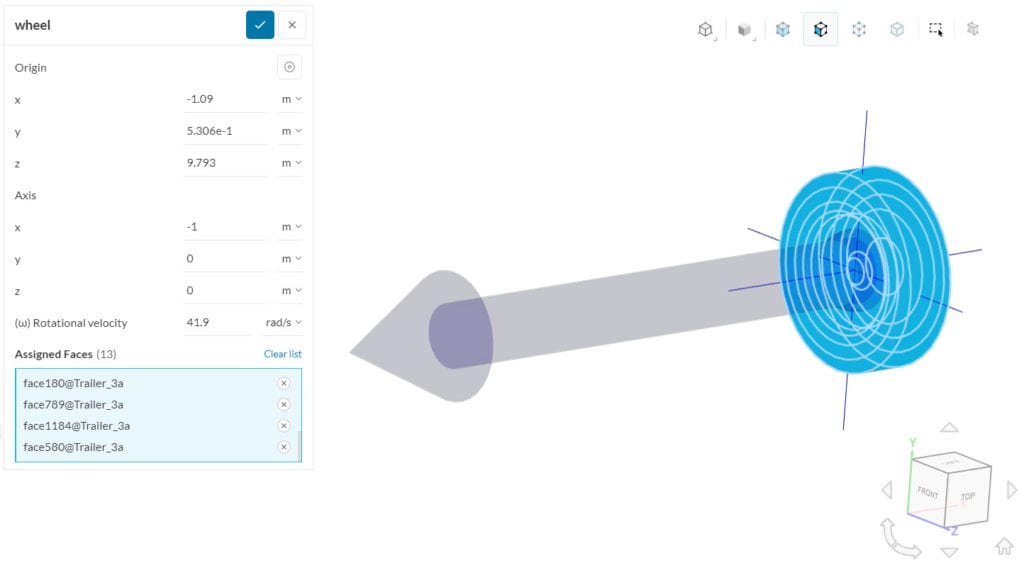
This boundary condition is a weaker representation of a rotating body than an MRF zone. Only a local rotational velocity is applied on the surface, without any additional effect or actual rotations. Hence, it can be used to accurately model axi-symmetric (cylindrical, spherical) rotating parts. For e.g., modelling rotating wheels, where only the flow behavior ofclosed wheel rims needs accurate prediction.
References
Last updated: May 2nd, 2025
We appreciate and value your feedback.
What's Next
Advanced Modeling LBMpart of: Pedestrian Wind Comfort Analysis
Sign up for SimScale
and start simulating now
